



There is always a Biggest Problem
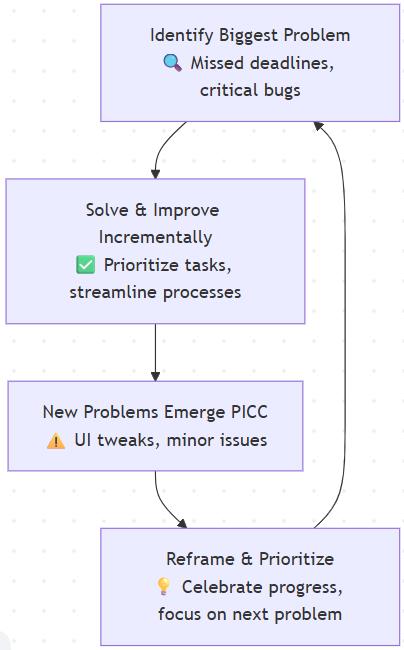
What’s the biggest problem you’re facing right now? Maybe it’s a missed deadline, a strained team dynamic, or a personal habit you can’t break. Solve it, and a new challenge—often smaller—takes its place. As you can imagine, now that a smaller problem has hit your radar, you'll likely find there are many more problems of that size. Now you have more "biggest" problems than before. This cycle is universal, driven by what psychologist David Levari calls "prevalence-induced concept change" (PICC), where we redefine smaller issues as "significant" once major ones fade. In this post, we’ll explore how incremental growth—small, consistent improvements that compound over time—fuels progress, while PICC reshapes our perception of challenges. By embracing this dynamic, we can unlock endless growth opportunities, even if it means never feeling “done.”
The Power of Incremental Growth
Incremental growth is about small, deliberate improvements that yield big results over time. Picture a savings account: modest deposits, made consistently, grow into wealth. In business, a customer service team might cut response times by 50%, then refine response quality. In personal development, journaling for five minutes daily can sharpen self-awareness over months.
I recall joining a development team and inheriting a large backlog of identified issues. By collaborating with our business groups, we created a set straightforward method for prioritizing tasks, moving away from random choices or the loudest stakeholder’s demands. With this in place it was clear how to address the backlog. Soon, we noticed smaller, persistent issues and easy-to-fix problems, like inconsistent fonts, grammatical errors in user notifications, or unresolved customer defects. These weren’t failures—they showed progress. Having clearly stated priorities allowed us to have informed decision when we deviated from the norm. Addressing the biggest issues first created space to tackle these refinements. Like product development or fitness routines, steady, small steps drive incremental growth and build momentum.
Prevalence-Induced Concept Change: Why New Problems Emerge
David Levari’s 2018 study on prevalence-induced concept change (PICC) explains why new problems appear. As big issues diminish, we expand what counts as problematic. In experiments, people labeled neutral faces “threatening” once overt dangers became scarce. In business, a startup might fix a failed product launch, then focus on minor interface tweaks. In personal growth, paying off debt shifts attention to optimizing savings.
In business, PICC is everywhere. A startup might overcome a catastrophic product launch failure, only to fixate on minor user interface tweaks in the next phase. Similarly, an individual who conquers a major obstacle—like paying off debt—might suddenly notice smaller stressors, like optimizing their budget for savings. On recent service trip, and in communication with a couple non-profit charitable organizations, it's been fascinating to see the transition from their initial service to something very different as initial needs were met. Once "getting children to school" has been "solved", the problems branch and multiply:
- training must be high quality,
- families need support,
- homework needs to be addressed,
- health of children,
- health of family members,
- general living conditions,
- legacy -- opportunities need to help the students work within the community or the opportunities are a drain on the community, not an asset.
This illustrates how solving one problem sharpens our focus on the next, often revealing needs we hadn’t anticipated. PICC drives continuous improvement but can also make progress feel elusive, as the goalposts keep shifting.
The Motivation and Challenge of Ever-Expanding Problems
This cycle of new problems is both motivating and exhausting. It’s energizing to know there’s always room to grow—a manager who boosts team productivity might eagerly tackle work-life balance next. Yet, it can feel relentless, as no achievement seems final. Picture a project manager who eliminates missed deadlines with a new workflow. Her team celebrates, but new concerns, like meeting overload, emerge. PICC shows this is natural: solving big problems sharpens focus on subtler ones. The challenge is balancing the drive to improve with appreciating progress. Removing one bottleneck in a process, will always expose the next one.
Strategies for Embracing the Cycle
The interplay of incremental growth and PICC shows that everyone has a “biggest problem” at any given time. The key is to harness this cycle for growth without being overwhelmed by it. Here are three practical strategies to do so:
- Prioritize Ruthlessly: You can’t solve every problem at once. Identify your current “biggest problem” and focus on it exclusively. Use tools like the Eisenhower Matrix to distinguish urgent tasks from distractions, ensuring your energy targets what matters most.
- Celebrate Milestones: Progress can feel fleeting when new problems emerge. Counter this by celebrating wins, big and small. Acknowledge when a major issue is resolved—host a team lunch or reflect personally on your growth—to reinforce the value of incremental steps.
- Reframe Challenges: When new problems arise, see them as evidence of progress, not failure. Your ability to notice smaller issues means you’ve already tackled the bigger ones.
Take the Next Step
Your biggest problem today isn’t a burden—though I'm sure it feels like it -- but the reality is that it’s a chance to grow. Whether you’re a leader streamlining team processes or you're refining personal habits, incremental growth transforms challenges into stepping stones. Yes, new problems will emerge, but that’s the beauty of progress: there’s always a next step to take. So, what’s your biggest problem right now? Take one small, intentional action toward solving it today. That single step could be the start of something extraordinary.
