


From Road Hockey to Real Life
I was out for a walk in the neighborhood the other day when I heard the familiar sound of sticks clacking and kids shouting. A group of them had set up for road hockey right in the middle of the street. They were picking teams.
It took me straight back to my own childhood—the same ritual, the same nervous energy standing in the lineup. Sometimes it was random: everyone threw their sticks into a pile in the center, someone tossed one left, one right, alternating until the teams were formed. Fair enough, no favorites shown. But most days a couple of the biggest kids or the best players stepped forward as captains. They’d face the group, arms crossed, surveying the crowd like they were choosing sides in a war. One by one names were called. And of course, someone always ended up as the last one picked. That quiet sting never quite goes away…so I’m told 
Watching those kids, I realized the game hasn’t changed much—just the stakes and the players. We’re still picking teams every day: at work, in friendships, in the quiet decisions that shape our days and our character.
When I got to be captain back then, the choice felt surprisingly complex. I could pick my best friend—awesome, loyalty and laughs guaranteed. Or I could pick the best player—awesome, we’d have the best chance of winning! But what if they weren’t the same person? Do I go with the friend who makes everything more fun (and might expect my status boost), or do I go with the kid who is likely going to be an MVP? The answer depended on what I valued most in that moment: winning the game, or keeping the friendship intact.
Fast-forward to adulthood and the same question echoes louder.
At work, there are plenty of great people and plenty of very competent people. But the overlapping set—the ones who are both enjoyable to work with and exceptional at what they do—rarely fills an entire org chart. So who do I really want on my team? Someone I like spending time with, or someone I can count on when the pressure is on?
In a hierarchy it gets even sharper. Would I rather have a manager who’s friendly and easy to talk to, or one who has my back when the stakes are high and actually knows what they’re doing? Same question for the people who report to me: the likable one who brings good energy, or the reliable one who delivers even when they’re not the life of the party? Obviously the ideal is both. But life rarely hands us the ideal package. There are trade-offs.
As I kept walking that day, I started thinking about the people already in my life and started thinking about people who I’d want on my team, or not, and people I liked spending time with and people I avoid. If I had to rate each one on two simple scales, what would the scores look like?
- On a scale of 0–10: How much do I want to spend time with this person? Do they leave me feeling lighter, seen, energized—or drained?
- On a separate scale of 0–10: How competent are they? Can I count on them when it matters—do they show up, follow through, have my back, look out for the team?
I’m an engineer. I like math. I’m a visual guy. I went to a graph in my mind.
X-axis: People I don’t want to spend time with ←→ People I want to spend time with.
Y-axis: People I don’t see their competence ←→ People I want their competence.
Requiring very little imagination, I saw four quadrants, with names in each.
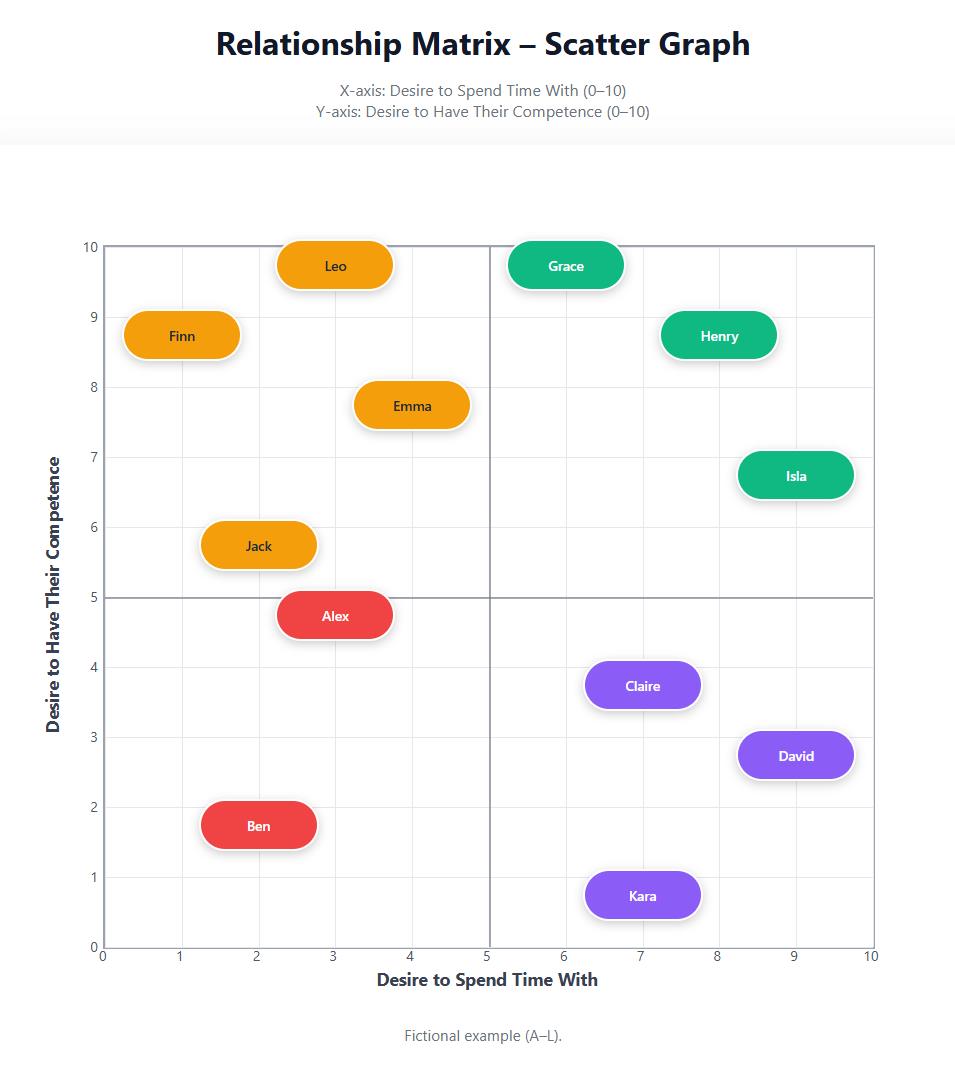
Top-right: High on both—the sweet spot. People you enjoy and trust when things get hard.
Top-left: Reliable when it counts, but you wouldn’t necessarily invite them for a coffee after work or a weekend BBQ.
Bottom-right: Fun to be around, great listener, warm energy—but you wouldn’t hand them the keys in a crisis.
Bottom-left: These relationships often fade naturally or require boundaries to protect your energy. They tend to be the people you try to avoid.
What tips someone high on each axis? Here are some common traits:
High “Spend Time With” (Expressive)
- Kindness / warmth
- Good sense of humor / playfulness
- Empathy / deep listening
- Authenticity / non-judgmental
- Fun-loving energy
High “Competence” (Instrumental)
- Reliability / dependability
- Integrity / honesty
- Accountability / ownership
- Supportiveness / loyalty
- Resourcefulness / problem-solving
The matrix isn’t about judging people as good or bad. It’s a mirror. It shows what you actually value in relationships right now—your current compass.
And here’s the humbling part: your compass isn’t universal. What sends someone crashing to the bottom of your grid might barely register for someone else. A single lie might be non-negotiable for you—automatic low-expressive, maybe low-instrumental too—because trust is sacred. For another person that same lie might be offset by extraordinary generosity or deep listening; they stay high-expressive because compassion outweighs the flaw. Your priorities shape the map. That lie might indicate what they’d do to have your back, if they needed to. That subjectivity is powerful. It means the grid isn’t static truth. Rather, it’s a living reflection of your values. And values can be refined.
The real tension shows up in the mismatches. The fun friend who flakes in a crisis leaves you feeling let down; the rock-solid colleague who’s socially awkward can make collaboration efficient but joyless.
In addition to it being a reflection of where you’re at, it can help you help others! If you have a relationship that doesn’t falls low on the scale of people you want to spend time with, you have now put a value to it. This creates an opportunity to ask “why?” and to even consider what it would take for you to want to spend time with them! What would have to change in them and in you?
And we can reverse-engineer this a little, too. If we understand someone else’s compass, the things that are their deal-breakers and their amplifiers, we can interact more deliberately. We can choose to show up in ways that honor what matters most to them: more transparency if honesty is their north star, more presence if listening is their currency, more reliability if dependability is what they prize.
I really liked this until I thought about how this could be abused. Could I do this without becoming manipulative or fake?
Thankfully, yes! If the intent is mutual elevation rather than extraction or utilization. Adapting isn’t the same as performing. When you deliberately practice truth-telling, generosity, or deep listening because you see it matters to them and because you want to grow in those virtues yourself, it’s not a ruse. It’s a bridge. “Fake it ’til you make it” can be ethical when the faking is rehearsal for real character change. Think about the fact that you have to "pretend" to be asleep so your body can finally fall asleep. The act becomes the habit; the habit becomes who you are.
Of course, there need to be guardrails. For example, I can’t think of a time when telling the truth (or not lying), for example, is ever wrong, but reckless delivery can wound. Generosity is beautiful, but one-sided giving breeds resentment. Doing good is noble, but unsolicited “help” (or simply too much help) can disempower. The moral question is always: Does this serve the highest good we both know, or just mine?
In the end, the matrix isn’t about perfect picks. It’s about wiser ones. From road hockey sticks to org charts to the company we keep, the teams we choose shape the trajectory of our lives. They shape who we become.
So maybe the next steps seem pretty straightforward:
- Sit with a notebook (or a spreadsheet, or the back of an envelope). Plot a handful of key people. No judgment—just honest scores.
- Then ask the inverse: How do I think I land on their grids?
- And finally: What small, repeatable action could move me one notch closer to the top-right quadrant in someone else’s eyes—without betraying my own highest good?
- Revisit the grid in a month, or a quarter.
- Look for shifts. Celebrate the incremental progress.
That’s aiming up—not in giant leaps, but in deliberate, compassionate steps.
We’re all still picking teams. Be deliberate and understand your choices!
The question is: Who are we choosing to become, one relationship at a time?
If this resonates, try your own grid this week and keep Aiming Up!
