


Wasting Time on Self-Improvement?
Play the Infinite Game Instead
Why Finite Goals Burn You Out — And How an Infinite Mindset Turns Aiming Up into Sustainable Growth
Have you ever strived to be a "good" employee, "good" employer, "good" parent, or "good" spouse?
We chase these ideals relentlessly—staying late to impress the boss, sacrificing sleep for our kids, trying to be the perfect partner—yet the goalposts keep shifting. What does "good" even mean?
There are common traits (reliability, kindness, responsibility), but the real measure of goodness is deeply contextual. One person's idea of love or support might completely miss the mark for another.Many years ago, early in my marriage, I was introduced to Gary Chapman's The 5 Love Languages, which illustrates this perfectly: some people feel most loved through words of affirmation (sincere compliments), others through acts of service (helping without being asked), quality time, gifts, or physical touch. Speak the wrong language, and your best efforts create distance instead of connection.Good things to know starting out in marriage! "'Til death do us part" is an awfully long time to harbor unresolved grudges in marriage—or let bitterness erode family bonds.
Or consider parenting. What makes a parent a “good” parent? Jordan Peterson observes: "Do not let your children do anything that makes you dislike them." Why? Because in a lifelong relationship, unchecked behaviors build resentment over years. However, what’s the timeframe for such a correction or redirection? What must we tolerate for a short time, but still have definite limits? What a “good” parent does isn’t black-and-white.
These everyday pursuits reveal a hidden truth: Being "good" isn't about hitting a finish line or checking boxes. It's not a finite game with clear winners. It's an infinite one—where the goal is to keep playing well, adapting to changing contexts, and perpetuating meaningful relationships long after the initial motivation fades.
Yet most of us approach self-improvement and much of life as finite: "Become the perfect parent/partner/leader by next year." When life shifts, results don't stick, we burn out or quit; or worse, we get the "win", but it feels hollow and temporary. If the game is to hit an arbitrary goal or metric it’s easy to justify taking risky shortcuts or even cheating to get there. That's the mindset mismatch Simon Sinek exposes in The Infinite Game.
Sinek's Core Distinction: Finite vs. Infinite Games
Simon Sinek, building on philosopher James P. Carse's work, distinguishes two types of games:
- Finite games have fixed rules, known players, clear beginnings and ends, and winners/losers (e.g., chess, a football match, quarterly earnings targets). The objective is to win.
- Infinite games have changeable rules, players who come and go, no defined endpoint, and the primary goal is to keep playing—to perpetuate the game as long as possible (e.g., business, politics, education, relationships, life itself).
If you remember nothing else, remember this, and think about it often whenever you are planning your next initiative, "In finite games, the goal is to win. In infinite games, the goal is to keep playing."
The Frustration of Chasing "The Best" in Business
This finite obsession shows up vividly in how many companies and organizations craft their vision and mission statements. They proudly declare they offer the "best service," "best value," or "best quality" in their industry.
Yet multiple competitors in the same space make identical claims. How can everyone be "the best"? It quickly becomes frustrating and hollow—because "best" depends entirely on the fine print: the specific metrics chosen (customer satisfaction scores? profit margins? speed?), the context (for budget-conscious buyers? luxury seekers?), and the arbitrary time-frame (this quarter? this year? forever?).
These claims are cherry-picked and temporary at best. One shift in market conditions, new technology, or customer preferences, and the "best" crown slips away. Leaders can fixate on defending or reclaiming it, leading to short-term tactics, ethical corners cut, and exhaustion. In an infinite game like business, proclaiming "we're the best" isn't inspiring—it's a fragile, finite illusion that distracts from true endurance and contribution.
Many leaders treat the infinite game of commerce as finite—obsessing over beating competitors, market share, or being "#1." This leads to short-term thinking, ethical shortcuts, burnout, and fragility. Companies chasing quarterly wins often collapse when the landscape shifts, while resilient ones (like Apple under Steve Jobs) focus on long-term innovation, a cause, and inspiring ongoing contribution.
Is it possible to be the “best” in an area? Of course. Is it desirable to be the best in an area? Of course! But what is the context? What are the trade-offs? What was sacrificed in other areas to be best in this one?
Why This Mismatch Plagues Personal Growth
The same finite thinking sabotages our personal lives. We treat self-improvement like a project with a finish line: "Run a Marathon", "Lose 20lbs", "Read 52 books", "Fix my relationships." We chase "before/after" photos and victory celebrations.
When the goal is reached (or life intervenes—new job, injury, changing priorities), motivation vanishes. Old habits return. We might even feel like failures when that happens.
But life isn't a sprint to a finish line—it's a marathon of a journey. The rules change (aging, new responsibilities, evolving needs), players shift (kids grow up, friends drift), and there's no permanent "win."
Aiming Up through small, consistent adjustments that compound over time—is inherently infinite. It's inherently infinite. We focus on perpetuation, purpose and direction, not finite endpoints.
To be clear: This series, this post, the whole concept of “Aiming Up” isn't about becoming a "better person" in some vague, ego-driven sense—or chasing generic self-improvement for its own sake. We’ve already questioned what “good”, "better", and “best” even means!
Finite games feed our ego with dopamine hits from milestones, temporary wins, and the pride of "being the best" (or at least better than yesterday's version of someone else). That can breed self-centeredness, comparison, and arrogance—making us fragile when we inevitably fall short or the goalpost moves.
Instead, we're aiming to get better at playing the infinite game—at advancing our own Just Cause, that compelling, service-oriented vision of a future worth lifelong contribution (for ourselves and others). Along the way, we can (and should) set exciting, incentivizing goals—they provide those motivating dopamine boosts and keep us engaged. But the overarching orientation is humbling: There's no ultimate "best," no finish line to conquer, only perpetual progress, adaptation, and contribution. Infinite play strips away pride and replaces it with quiet resilience and a focus on something bigger than self. It allows us to celebrate the journey of progress and the milestones along the way. It invites us to engage with others to advance our Just Cause. It allows us to celebrate the victories of others without feeling diminished in the process. Infinite games are not zero-sum games.
Adopting this mindset turns self-improvement from exhausting chasing into a sustainable, directed journey. It requires both long-term vision (your Just Cause keeps you oriented) and short-term flexibility (habits adapt as life evolves).
Key Takeaways: Finite vs. Infinite Mindset in Personal Life
- Finite mindset traits: Pressure from comparison, burnout from arbitrary deadlines, fragility to setbacks, score-keeping in relationships, obsession with "perfect" versions, ego inflation from wins.
- Infinite mindset traits: Resilience through adaptation, fulfillment from contribution, legacy focus, internal advancement (better at the game than yesterday), humility in the face of endless play—no true "winners," only being ahead at moments, with the real prize being continued contribution and inspiring others.
In short: There's no finish line—just a version of you that is actively, consciously, advancing your Just Cause. Ideally, you’ll work on it today, tomorrow, and the day after, in service of something enduring. You'll have a chance of finding satisfaction and fulfillment in that endeavor.
Your Infinite Game Audit: Start Reframing Today
Pick one life area (health, relationships, learning, career). List your current finite goals. Then reframe them infinitely—anchor them to a bigger, enduring "why" that keeps the game going.
Examples:
- Finite: "Run a marathon by year-end."
- Infinite: "Cultivate lifelong vitality so I can adventure energetically with family for decades, contributing presence and energy to those I love."
- Finite: "Have weekly date nights."
- Infinite: "Build a resilient, trusting partnership that adapts through life's changes, so we keep choosing each other 'til death do us part.'"
Starter habits to keep playing better each day (not to-dos to check off):
- Health: Daily 5–10 minute walk—focus on feeling energized, not hitting steps.
- Relationships: One gratitude text to a partner/friend—tune into their love language over time.
- Learning/Hobbies: 10 minutes of curious reading/listening—prioritize lifelong curiosity over "mastery in 30 days."
These small re-frames compound. They build momentum without the pressure of endpoints.
Introducing the Infinite Aiming Up Series
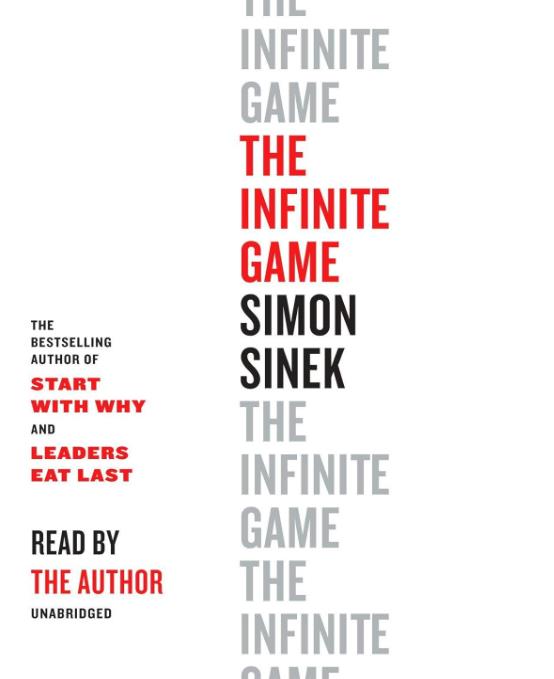
This is Post 1 in a series applying Simon Sinek's framework to personal growth—starting with the core distinction, then diving into his five essential practices. Drawing from his book, The Infinite Game, we’ll be looking at many of the following topics, to name a few:
- Advancing Your Just Cause – Define a personal "why" worth lifelong effort.
- Building Trusting Teams – Foster safety in your inner circle (and self-relationship).
- Studying Worthy Rivals – Turn inspiration (not comparison) into growth.
- Preparing for Existential Flexibility – Make bold pivots when life demands it.
- Finding the Courage to Lead – Prioritize long-term over easy wins.
- The Courage to Aim Up – Face resistance and keep going.
- No Finish Line – Measure progress through fulfillment and legacy.
Sinek has a definite business lens in his book, so we’ll start there, but we’ll look at delivering practical, habit-focused applications for every aspect of life, too.
The Shift Starts Now
Shift from finite chasing to infinite playing, and self-improvement stops feeling like a waste. It becomes sustainable aiming up—directed, adaptable, fulfilling, and humbling in the best way.
Do the Infinite Game Audit this week. Pick one area, reframe a goal infinitely, and try one starter habit. I’d love to hear how it goes for you!
There's no finish line—just the quiet joy of playing the right game, better each day, for something bigger than ego.
Thanks for reading and keep Aiming Up!
